Redfish are the reason a lot of people find their way to Homosassa for the first time. They are also the reason most of them come back. There is no other inshore species on the Nature Coast that is as available, as willing to eat, and as flat-out satisfying to catch on light tackle. I have been targeting redfish on these flats my entire life and I still look forward to every morning that starts with an incoming tide and clean water over hard bottom.
The quick answer: Redfish on the Homosassa flats are best targeted on incoming tides over hard bottom in one to three feet of water. Live shrimp on a jig head or soft plastics worked slowly along structure produce fish year-round, with peak action in the fall. The key is reading the flat correctly — bottom type, water clarity, wind direction, and tide stage all factor into where fish will be and how they will eat.
Here is what I know about catching them on the inshore fishing charters I run out of Homosassa.
What Makes Homosassa Redfish Fishing Different
The Nature Coast is not like the east coast of Florida or the panhandle. There are no long sandy beaches and very little development along the water. What we have instead is a vast, shallow estuary system fed by freshwater springs, bordered by mangroves and marsh grass, and cut through by tidal creeks that push clean water in and out twice a day. That system produces enormous numbers of redfish because the habitat is essentially perfect for them.
The shallow flats south of the Homosassa River hold redfish year-round. The Chassahowitzka River system to the south adds another dimension. St. Martins Keys, the outside keys, and the nearshore rock structure give fish structure to orient to. The backcountry creeks and the areas around the treeline hold fish on high tides when they push up to feed in very shallow water. A redfish does not have to travel far in Homosassa to find everything it needs. That is why they stay.
What this means for you as an angler is that you are not gambling on a migration window or hoping a seasonal run shows up. Redfish are here. The question is which flat, which tide, and what presentation.
Tides and Timing
Best Tide for Redfish
Tide is the first thing I check every morning. Everything else follows from that.
I prefer the incoming tide because fish are moving and easier to locate. When the water is rising, redfish push up from the channel edges and deeper pockets onto the flats to feed. They are covering ground and they are actively looking for food. That is when I want to be set up ahead of them, not chasing them.
The outgoing tide is just as productive when you target it correctly. As water falls off the flat, redfish stage on channel edges and drain points in ambush positions, waiting for bait to wash through. I look for points where a flat narrows down to a creek mouth or a channel cut and position the boat to cast up onto the flat and work the bait toward the dropping water. Incoming is best for searching. Outgoing is best for finding fish already committed to a spot.
Early morning is my preferred time, especially in summer. Redfish feed aggressively in low light before the sun gets up high and warms the shallow water. In fall and winter I will fish later into the morning because the cooler water keeps fish active longer.
Moon Phase and Water Movement
If I had a moon phase to choose, I would always vote for the new moon. New moon tides bring stronger water movement and push higher floods onto the flat, allowing redfish to spread farther into the backcountry and feed across a wider area for longer periods. Instead of fish stacking on a single stage of the tide, they move with the water all the way through the flood cycle. The October new moon tides are the best redfish fishing of the year on this coast, and I say that without any hesitation.
Reading the Flat: Wind and Water Clarity
Wind Strategy
Wind matters on the Homosassa flats and most anglers do not think about it until they are already on the water with a problem.
On windy days I look for leeward shorelines — the banks where wind has been blowing toward rather than away from. Bait stacks up on the windward shoreline and redfish follow it. The windward side is typically muddier and harder to read visually, but if the bite is slow on clean water, I move to where the wind is pushing water and look for fish feeding by smell rather than sight.
Wind direction also determines whether I pole or drift. A steady wind across the flat is sometimes a better ally than the push pole. I set the drift along the depth contour I want to cover and manage it with the motor rather than burning energy poling into the wind. On days with no wind at all, the push pole is the only quiet option.
When wind is pushing against an outgoing tide, the flat can turn muddy fast. If the water is off-color and getting worse, I move. There is usually a cleaner pocket somewhere in the system. The backcountry creeks hold cleaner water longer than the open flats when wind is mixing things up.
Water Clarity
The water in the Homosassa system is not always clean. Spring-fed clarity is the ideal, but tidal movement, wind, and weather can stain the flat quickly. What matters is knowing how fish behave in each condition.
In clear water, redfish are actively sight-feeding and they will flush from noise, boat shadow, or a hard bait entry. Approach quietly, lead the fish, and keep the presentation gentle.
In stained or off-color water, redfish shift to feeding by smell and vibration. They are less spooky and less visually oriented. Shrimp on a jig head is the right call in low-visibility conditions because the scent trail does work that a plastic lure cannot. Slower presentations give the fish time to locate the bait. I will also go to darker colors — watermelon red flake, motor oil, dark rootbeer — in stained water because they produce more silhouette contrast than lighter colors.
Know what the water is doing before you decide on your presentation. A glow jerk bait on a sight-fishing flat is a different tool than a scent-soaked shrimp in dirty water, and using one when the conditions call for the other is a way to make a slow day slower.
What to Look For: Reading Fish on the Flat
Polarized sunglasses are not optional on a sight-fishing flat. They are the single most important piece of equipment you have on the boat. Without them, you are fishing blind.
Once you have the right eyewear, here is what you are looking for.
Tails are the most obvious signal. A redfish feeding in very shallow water will tip up, and the tail breaks the surface. You will see it rocking slightly as the fish roots through the bottom. Do not rush the cast. Watch the direction the fish is moving, lead it by several feet, and let the bait settle before you start the retrieve.
Pushes are the second thing to watch for. A push is the V-shaped wake that a fish leaves moving through shallow water at speed. It is visible at distance on a calm day. Read the direction of the push and figure out where the fish is headed. Cast ahead of it, not at it.
Nervous water is subtler. A small disturbance on the surface, a slight ripple in an otherwise flat area, often indicates fish moving below. It is the kind of thing you develop an eye for over time. When you see it, slow down and look before you make a move.
On overcast days or in deeper water, you are mostly reading bottom rather than fish. Look for the color change at a bottom transition — the edge where rock grass meets clean hard bottom — and work along it. Fish will be on that edge whether you can see them or not.
Approach and Position
A redfish in eighteen inches of water knows you are there before you think it does. The approach is not an afterthought.
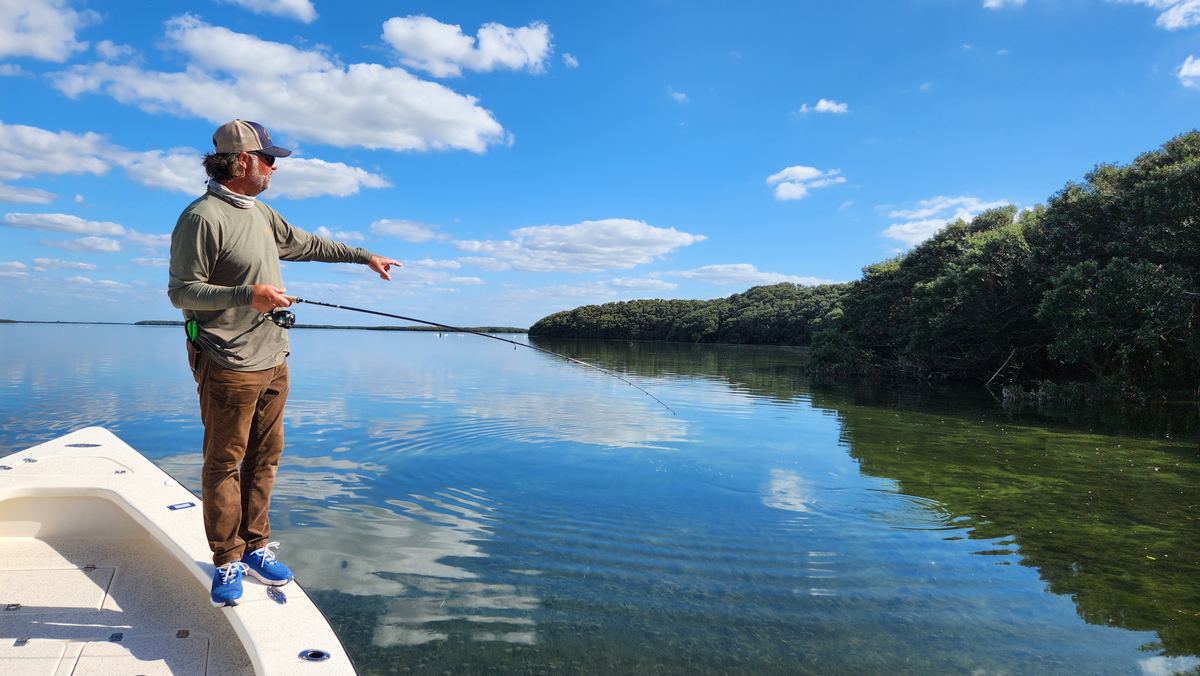
I use the push pole whenever conditions allow. It is quiet and it gives me complete control over the drift. A trolling motor is faster but noisier, and in very shallow water on a calm day the low-frequency hum travels far. If I use the motor to get to a flat, I shut it off well before I start fishing and let the flat settle for a few minutes.
Casting angle matters more than most people think. An up-current presentation — casting so your bait drifts naturally toward a fish the way real bait would in the tide — gets eaten more consistently than a cast that pulls the bait across the current or retrieves it unnaturally. Think about where the water is going and put your bait in front of the fish the way the tide would deliver it.
One person casts at a time on a shallow flat. Two people casting at the same fish is two people spooking the same fish. I suggest a feathered cast — slow the line with your fingers as it comes off the reel so the bait enters the water softly. A hard splash in a foot and a half of water is the end of that opportunity.
Best Depth and Bottom Type
Location on the Homosassa flats comes down to bottom type and water depth. Redfish are not randomly scattered across open water. They are on specific bottom with specific characteristics.
Hard bottom is the foundation. Ribbon rock, rock grass, and shell bottom hold more bait than soft mud or open sand. Redfish know this. I look for the transition zone where rock grass meets cleaner hard bottom and set up a drift along the edge of it. That edge concentrates everything — crabs, small baitfish, shrimp — and redfish work it like a conveyor belt.
South of the Homosassa River, yellow bottom marks the areas where the bottom composition shifts. That is productive territory for redfish in the warmer months. The outside keys give fish a tidal edge to work and provide some protection from boat traffic. In the backcountry, I fish the mouths of tidal creeks on the incoming tide and the inside bends on the outgoing tide.
Water depth from one to three feet is where I spend most of my time. At any given spot I like to give it at least fifteen minutes. If fish are there it will usually happen fairly quickly. If nobody is home, make a move to the next spot west.
Booking a redfish charter? Call Captain Toney at 352-422-4141 — fall dates fill fast and the October new moon weeks go first.
Best Baits for Homosassa Redfish
Live Bait
Live shrimp is my first choice for redfish on the Homosassa flats, particularly in clear water when the fish are actively sight-feeding. When the tide is right and you put a lively shrimp in front of a redfish that is looking for food, the result is usually predictable.
I catch my bait fresh every morning on the way to the fishing grounds. Fresh bait consistently outfishes weak or stressed bait, and shrimp that has been sitting in a bait well overnight is not performing at its best. A lively shrimp on a jig head moves differently than a slow one and the difference shows up in the bite.
For redfish around structure and on deeper incoming edges, I also fish live pinfish and cut mullet. Bigger fish in the fall sometimes want something with more profile than a shrimp. A live pinfish free-lined near structure will produce bull redfish that a smaller bait might not trigger. Cut mullet is an underrated option in stained water because the scent disperses widely and brings fish to the bait rather than requiring a perfect presentation.
To rig a shrimp, pinch the tail off and thread the bait onto the jig head tail-first. Push the shrimp so it hooks into the prongs or keepers on the neck of the jig head. I fish a 1/8 oz. jig head in most situations on the flat and go to 1/4 oz. on deeper incoming tide edges to keep contact with the bottom.
Work the bait on a slow lift-and-drop. Let it settle to the bottom, raise the rod tip just enough to move the shrimp and let it fall again. Slow and methodical is the best approach.
Artificial Lures
There are days when artificials outfish live bait and days when they do not come close. Learning which is which takes time on the water. Here is my starting point.
My go-to artificial for redfish is the D.O.A. 5.5 glow jerk bait with a 3/0 bait style hook right through the tip of the nose. It has a wide profile, it displaces water, and it moves like something that is injured. I work it on a slow twitch-and-pause. Let it sink between twitches. Redfish often eat it on the pause.
For a softer plastic presentation, I reach for MirrOlure Lil Johns in watermelon red flake on a 1/8 oz. D.O.A. jig head. That combination has produced redfish for me in all kinds of conditions. Bourbon and dark rootbeer are also productive when the water has any stain to it.
I fish these on a 7’6″ Boner 8 to 15 medium fast rod with 10 lb. Power Pro Braid and a Seaguar 20 lb. fluorocarbon leader. I run two to three feet of leader — enough to keep the braid away from the fish in clear water without making the connection awkward to cast. The fluorocarbon disappears and handles the abrasion of the grass and rock. Do not skip the leader. Clear water redfish see everything.
Seasonal Patterns: How Redfish Behavior Shifts
The techniques above apply year-round but the specifics change with the season and water temperature.
In winter, fish move off the open flats toward deeper channel edges and hard bottom pockets. Presentations slow down. I am lifting the bait less and letting it sit more. The bite is subtle and the fish are less aggressive, but they are still eating. Target the warmest part of the day and find fish on the outgoing tide where they have staged up from overnight holding spots.
In spring, redfish spread across the flat as the water warms. They are transitioning from winter edges to summer patterns and they are feeding more actively. This is a good time to cover water, find fish, and figure out which bottom type they are using. The outside keys and the areas south of the river start producing consistently in April.
In summer, fish early. The first two hours after sunrise on the outgoing tide over yellow bottom and hard rock is the summer window. By nine or ten in the morning the bite has usually slowed on the open flat. Night fishing around structure in the river is productive for redfish in July and August when daytime heat shuts things down.
In fall, the fish school. This changes everything about the approach. Instead of searching for individual fish or small groups, you are looking for concentrations. Once you find them, you stay on them. The fall flood tides push schools deep into the backcountry and they feed aggressively across the entire tide phase.
Fall Migration: The Best Redfish Fishing of the Year
September and October are when Homosassa redfish fishing reaches its peak. The fish school up in large numbers and push onto the flats in concentrations you do not see at other times of year. I have caught redfish, seatrout, and snook on a good incoming new moon tide from the outside keys all the way back toward the treeline in a single six-hour period following the water. That is what fall can produce here.
New moon tides in October bring stronger water movement and higher floods onto the flat, pushing fish deeper into the backcountry and keeping them actively feeding across the full tide cycle. When I get two or three bites in a row in the same area, I anchor up. The fish are almost always stacked tighter than the first couple of bites suggested.
This is also the time of year when redfish are most visible. Clear fall water and low sun angles make poling the flat for tailing fish a real possibility. Nothing about fishing is more satisfying than locating a tailing redfish from fifty feet away and putting a good cast on it. Fall gives you those opportunities.
A Note on Conservation
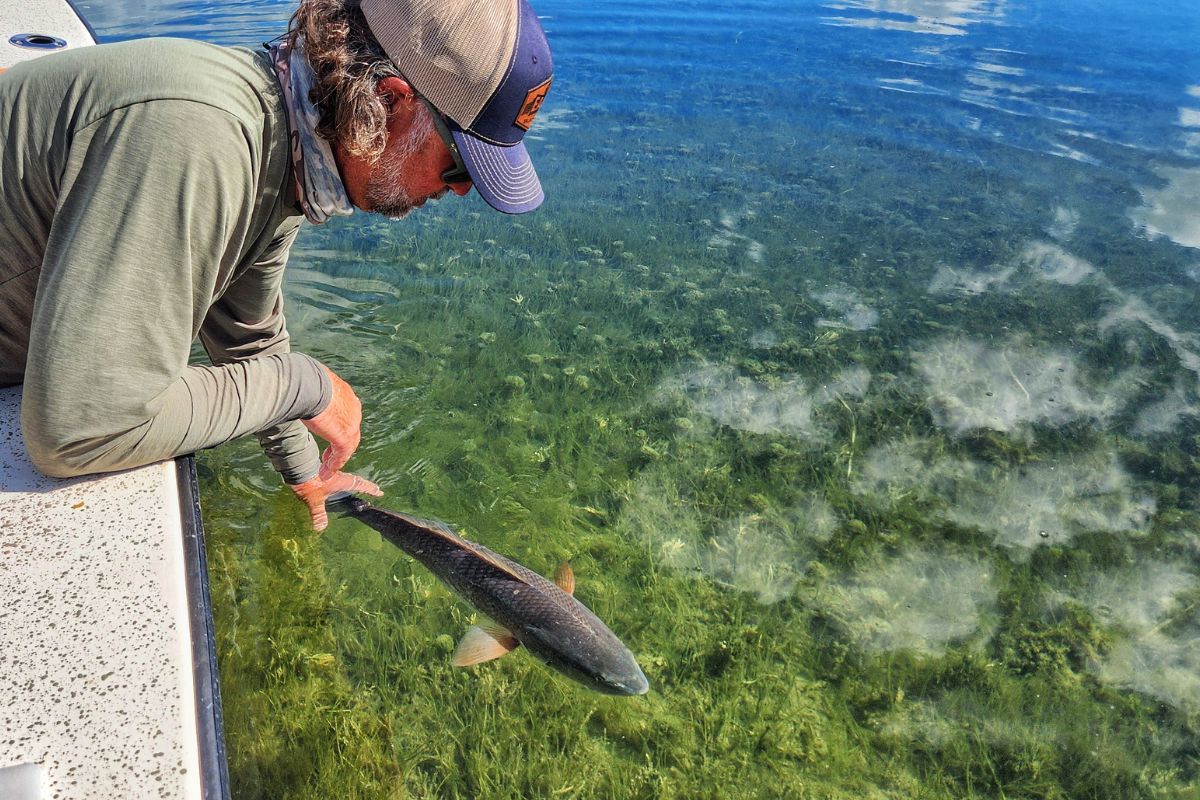
I recommend catching what you are going to eat and being thoughtful about numbers. Redfish are not fragile but they are a managed species, and the quality of the fishing here depends on keeping the population healthy. Release fish you are not keeping quickly and keep them in the water as much as possible. A healthy redfish released on a good tide will be on that same flat next October.
Watch Captain Toney’s Redfish Videos on In The Spread
I have produced a detailed video series on redfish tactics through In The Spread, covering live bait rigging, summer patterns, top five baits and lures, and the techniques I use every day on this water. These are not short highlight clips. They are full instructional videos built for anglers who want to understand the reasoning behind the approach, not just watch someone catch fish.
Watch Captain Toney’s Redfish Series on InTheSpread.com
Ready to Fish the Homosassa Flats?
Redfish season runs all year here. The fall window books fast and summer mornings are worth every early alarm. If you want to talk through the calendar and find the right trip for what you are after, give me a call.
Captain William Toney
Homosassa Inshore Fishing
Call 352-422-4141 to Book Your Redfish Charter