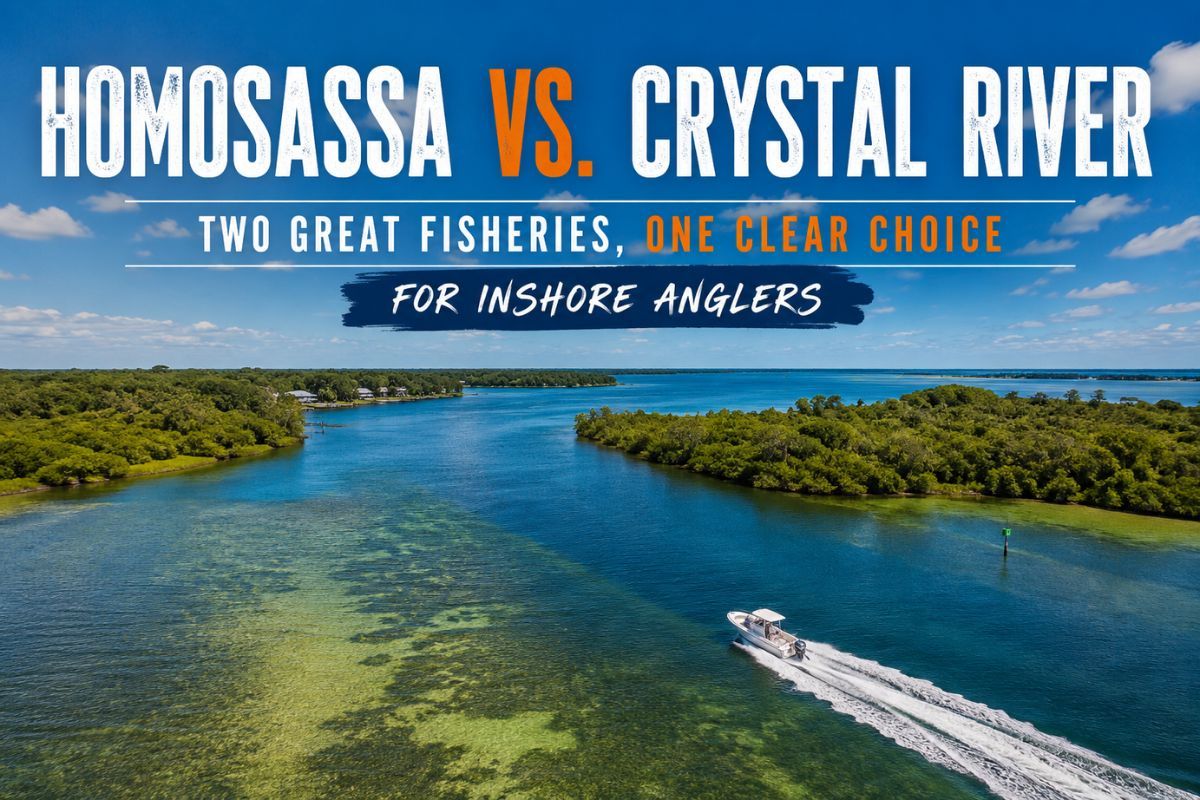
People ask me this question all the time, usually while they are booking a trip, and I appreciate that they ask it directly. It means they have done some research and they want a straight answer. I am going to give them one. But I want to do it honestly, because Crystal River is a legitimate fishery with a lot going for it, and I do not think it helps anyone to pretend otherwise.
The short answer is that for inshore fishing — redfish, seatrout, snook, and the broader Nature Coast species mix — Homosassa is the better choice. The longer answer explains why, and it also explains when Crystal River makes sense. Both are worth your time depending on what you are after.
Crystal River: What It Does Well
Crystal River sits about fifteen miles north of Homosassa and shares the same general ecosystem. It is a spring-fed river system that flows out into the Gulf through Kings Bay, and the water is clean, clear, and productive. If you have not been there, it is a beautiful piece of Florida.
What Crystal River is best known for is manatees. Kings Bay holds one of the largest concentrations of Florida manatees in the state, particularly in winter when warm spring water draws them in from the Gulf. Manatee tours operate year-round and they are popular for good reason. If swimming with manatees is something your group wants to do, Crystal River is where you go. Homosassa has manatees too, but the organized swim-with-manatee experience is centered up there.
Crystal River also has good scalloping grounds in season. The grass flats in the bay and surrounding areas hold bay scallops from July through September and scalloping out of Crystal River is a well-established summer tradition.
For fishing, Crystal River has seatrout, redfish, and snook, and there are guides who know that water well and do good work. The Crystal River Preserve State Park and surrounding marshes offer extensive light-tackle and kayak access for anglers who want to get into less-pressured areas on their own. Some guides operating out of Crystal River also run mixed trips that combine inshore with nearshore and offshore opportunities on the same day, which is a reasonable option if your group has different interests.
I have nothing bad to say about Crystal River. It is good water and there are good people fishing it.
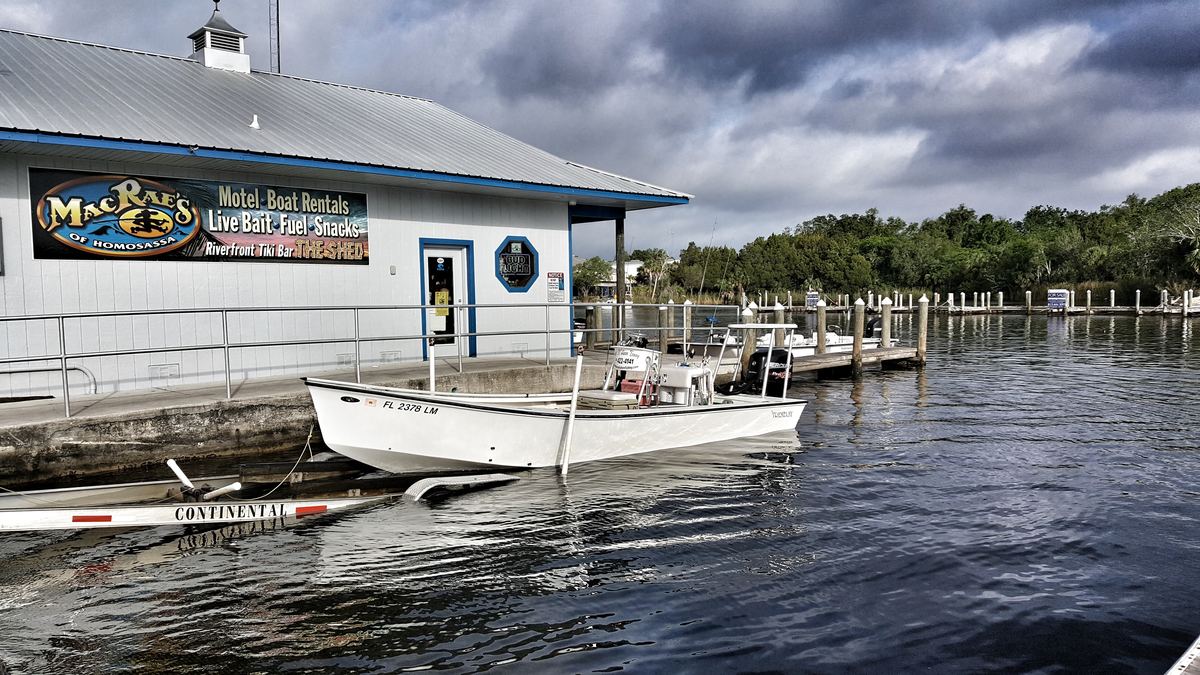
What Makes Homosassa Different as a Fishery
Homosassa sits at the heart of what Florida anglers call the Big Bend, the sweeping curve of the Gulf Coast where the panhandle transitions into the peninsula. This stretch of coastline has almost no beaches and very little development along the water. What it has instead is one of the most productive inshore fisheries in the southeastern United States.
The Homosassa River is spring-fed and runs clear year-round. It empties into a shallow estuary system that extends several miles offshore before the bottom drops away toward deeper Gulf water. The flats are a mix of hard bottom, ribbon rock, rock grass, and shell scattered across water that runs from ankle-deep at low tide to four or five feet at a good high tide.
From Homosassa, you are running directly into a wide apron of hard-bottom flats and outside keys that stay shallow for miles offshore. The productive water starts close and it keeps going. From Crystal River, more of the first part of the trip involves navigating channel-focused movement around Kings Bay and its boat traffic before you reach the kind of open, quiet flat I am talking about. That is not a fatal problem. It is just how those two rivers lay out differently once you leave the dock.
To the south, the Chassahowitzka River system adds another dimension entirely. The Chassahowitzka is one of the least-developed spring systems in Florida. The backcountry creeks down that way hold fish that do not see significant pressure. The pole line area in the Chassahowitzka is as good a piece of snook and redfish water as exists on this coast. Crystal River has backcountry creeks and mangrove shorelines too, but the combined reach of Homosassa and Chassahowitzka gives you a substantially larger, quieter stretch of contiguous water to work.
That is not a knock on Crystal River. It is just how the coastline lays out once you factor in both systems together.
Species Mix: Why Homosassa Produces More Consistently
The species available in Homosassa cover the full range of inshore Florida fishing and connect well into nearshore opportunities on the same trip.
Redfish are present year-round on the Homosassa flats and school up in significant numbers in the fall. The outside keys, the river mouth, and the backcountry creek systems all hold fish at different tides and different times of year. Following a good incoming new moon tide from the outside keys back toward the treeline, you can find redfish, seatrout, and snook in the same six-hour window.
Seatrout on hard bottom south of the river, particularly on yellow bottom and ribbon rock, are as reliable as any target species I fish. Sheepshead stack up on nearshore structure in winter alongside black drum. Mangrove snapper hold on rock and ledge. Spanish mackerel run along the nearshore rocks in spring and summer. Tripletail show up around crab buoys and floating debris in late spring, which most visiting anglers never think to target. Cobia move through in the spring along nearshore hard bottom. The way I run my Homosassa trips, the nearshore rock structure and the spring cobia and tarpon run are a natural extension of the same day. Crystal River-based charters can access that same general Gulf belt, but the run from Homosassa puts us on productive nearshore structure efficiently in a way that makes a mixed inshore and nearshore day easy to build.
For an angler who wants variety and wants to experience the full range of what the Nature Coast offers, Homosassa is the more complete base.
Boat Traffic and Fishing Pressure
This is a practical consideration that does not get discussed enough.
Crystal River sees significant boat traffic from manatee tours, recreational rentals, and charter operations concentrated in and around Kings Bay. On a busy weekend morning, that traffic affects the fishing. Redfish and seatrout on pressured, noisy flats behave differently than fish on quiet water. Noise travels far in shallow water and a shallow-draft boat moving too fast across a flat will push fish off it.
Homosassa has fishing pressure too. I am not going to pretend it is undiscovered water. But the backcountry creek systems, the southern flats toward Chassahowitzka, and the offshore rock structure give you options to get away from other boats in a way that Kings Bay does not. On a Tuesday morning in October, I can put you on fish without seeing another guide boat for hours.
The difference is access to undisturbed water. Homosassa has more of it and it is closer to the dock.
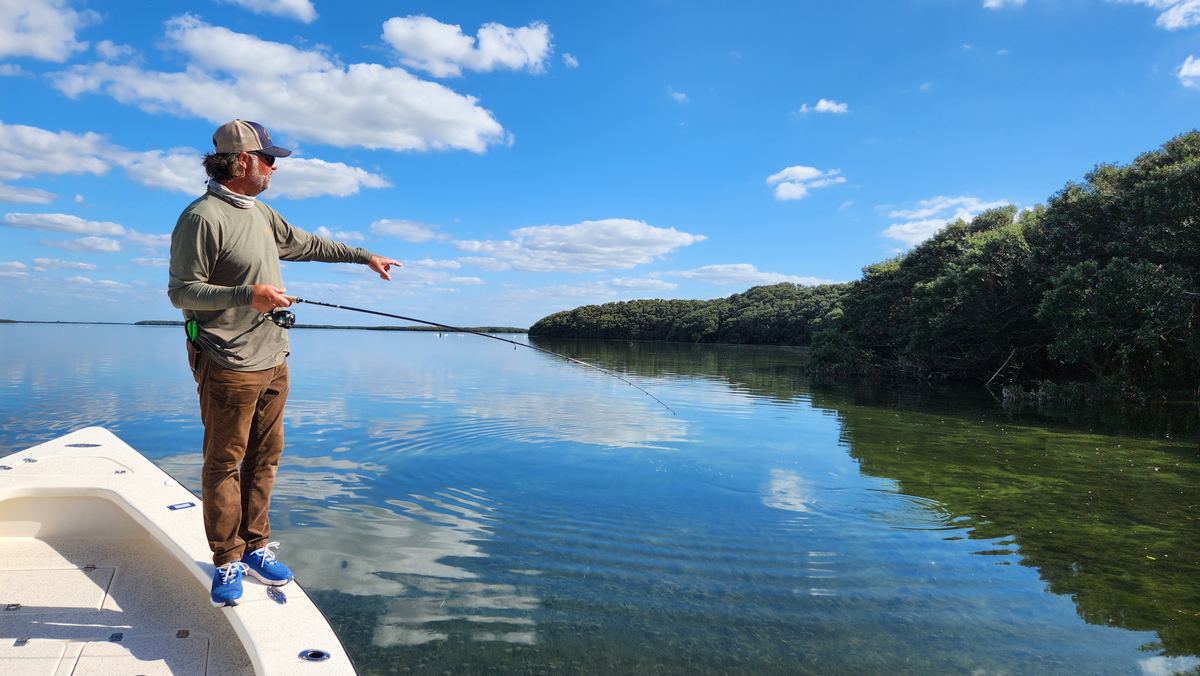
The Guide Knowledge Factor
Both Crystal River and Homosassa reward local knowledge. The flats are not self-explanatory. Bottom type changes across short distances, tidal flow behaves differently in different parts of the system, and the fish move based on subtle variables that take years of observation to understand.
My family has fished this water for four generations. My grandfather fished the same flats I fish now. I grew up watching my father read this estuary and learning from him the way the water moves, where fish hold on different tides, which bottom transitions produce fish in which seasons. That knowledge is not something you can get from a fishing app or a map.
When you book a guide in an unfamiliar area, you are buying access to that kind of accumulated knowledge. The question is how deep that knowledge goes. A guide who has worked Crystal River for ten years knows Crystal River well. A guide whose family has fished Homosassa for four generations knows something different. It is not a fair comparison.
I say that not to dismiss Crystal River guides, many of whom are good fishermen. I say it because it is the honest explanation for why local knowledge matters here and why the depth of that knowledge is not equal across every guide on this coast.
When Crystal River Makes Sense
If swimming with manatees is the primary goal, go to Crystal River. There is nowhere better for it in Florida.
If scalloping is what you want and the Crystal River grounds are open, that is a legitimate option alongside Homosassa, which also runs scalloping trips in season.
If you are staying near Crystal River and convenience matters, there are good guides up there who will put you on fish.
If your group includes people who want to do other things besides fish — Homosassa Springs Wildlife State Park is worth a few hours for families, and the area tends to feel quieter and less commercial overall than the Kings Bay marina corridor.
But if inshore fishing is the main reason you are coming to the Nature Coast, and you want the most water to work, the deepest backcountry, the broadest species mix, and a guide whose family has been reading this specific estuary since before there was a highway running through Citrus County, Homosassa is where you want to be.
The Honest Answer
Both fisheries are worth fishing. The Nature Coast as a whole is one of the most underrated inshore destinations in the Gulf Coast states, and that includes the water from Crystal River south through Homosassa and into the Chassahowitzka system.
But if you are choosing one area for an inshore fishing trip and the fish are the reason you are coming, the answer is Homosassa. More water, quieter flats, a larger backcountry to the south, and a nearshore fishery that connects naturally to the inshore trip you are already on. I have fished here my entire life and I am still finding water that surprises me. That does not happen on a small fishery.
Come see for yourself.
Captain William Toney
Homosassa Inshore Fishing
Call 352-422-4141 to Book Your Nature Coast Charter